
Miami-Dade County's Specialized Wanted List
Miami-Dade's sheriff does not post a giant roster of every fugitive. What the agency runs is a focused selection: the Most Wanted Sexual Predators and Offenders page. MDSO picks the entries, puts up names and photographs, and links each one to a Florida Department of Law Enforcement flyer. Updates come whenever the agency decides, with no published schedule. Someone absent from the page can still be wanted, and an old screenshot proves nothing about status today.
That narrow scope matters. A most-wanted page is a public appeal shaped by agency priorities. A warrant, by contrast, is a court order directed at law enforcement. The list cannot tell you whether a named person has one, and it says nothing about crime levels countywide. Before sharing a claim or sending a tip, recheck the official page and its linked flyers.
The official wanted page is documented as the proper source interface, not reproduced here as a local gallery of booking photographs. For any name or flyer that matters, open the current MDSO wanted list directly.
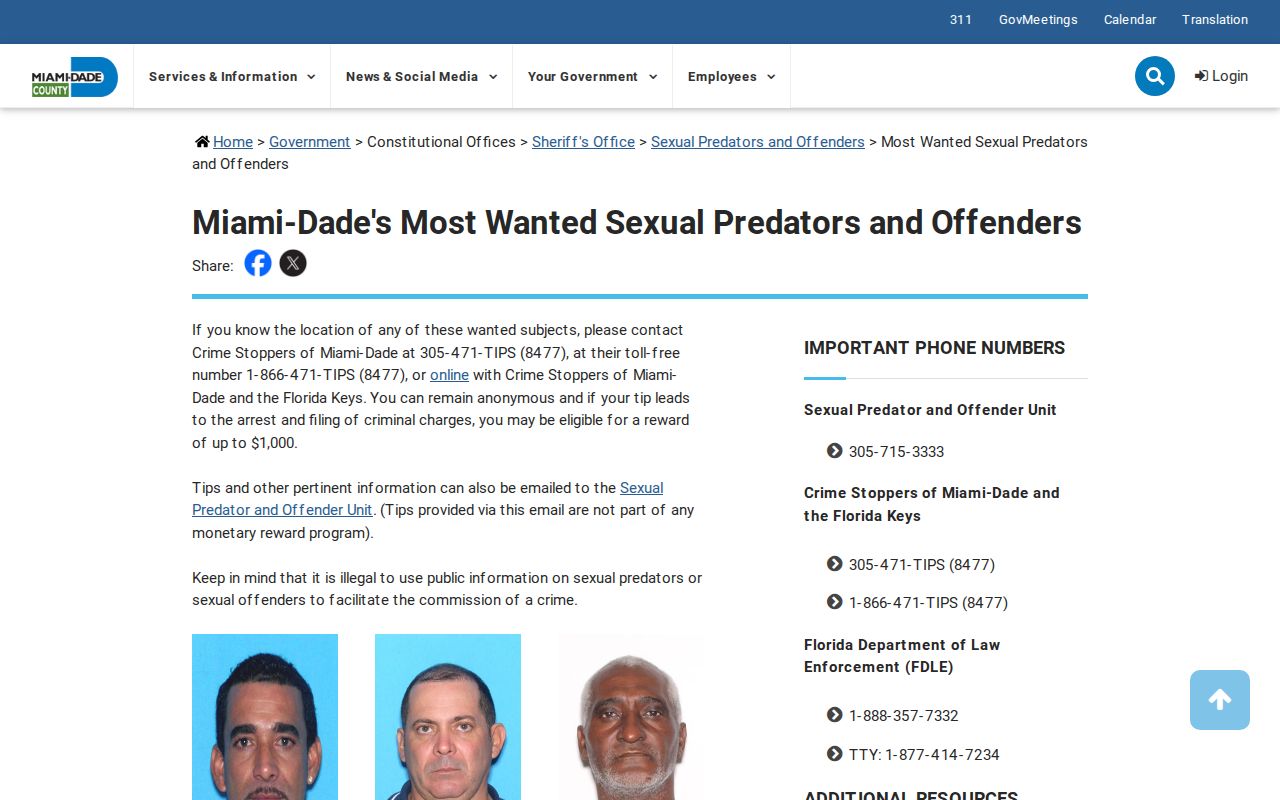
To see whether MDSO still shows an entry, or which FDLE flyer it links to, go to the county page itself. That is the authoritative spot.
Miami-Dade County Wanted Listing Fields
Each photographed entry on the verified page comes with a name and a link to an FDLE flyer. The flyer does the heavy lifting. It carries the agency's current identifying details and status information, which is why it should anchor any comparison. Resist the urge to fill gaps with social media posts, old news clips, or a face that merely looks similar. Match the text identifiers and the live flyer instead.
| Field | What it means |
|---|---|
| Name | The identity used on the official MDSO entry; confirm spelling against the linked flyer. |
| Photograph | An agency-displayed identification image. It does not prove present location or guilt. |
| FDLE flyer | The linked state notice that supplies the official detail behind the selected entry. |
| Wanted status | A status to verify on the live source because the county publishes no fixed update cadence. |
| Tip direction | The route for sending information to Crime Stoppers or law enforcement without approaching. |
Appearances shift. Names get shared by unrelated people. So a face alone never settles an identification. When a possible match comes up, write down the live page, the name displayed, and the place or time tied to your tip. Then hand it to trained staff for assessment.
Note: The entry count reflected only a dated snapshot, so no fixed total is stated as a permanent fact.
Use Miami-Dade County Wanted Notices
Start with official sources and end with them too. The point of a tip is to pass along useful information, not to investigate or confront anyone. MDSO social accounts sometimes spotlight fugitives or arrests, but posts vanish and never form a complete list. No verified official MDSO or MDCR jail-photo app exists.
- Open the live MDSO specialized wanted page and confirm that the entry remains present.
- Open the linked FDLE flyer and compare written identifiers rather than relying on the photograph alone.
- If recognition seems credible, move away and do not contact, follow, restrain, or alert the person.
- Send the location, time, direction of travel, and other direct observations through Crime Stoppers or law enforcement.
- Call 911 when there is an immediate threat, then follow the dispatcher's instructions.
Once an arrest happens, the person may land in MDCR custody at Turner Guilford Knight Correctional Center. That booking is a different record from the wanted flyer. The Miami-Dade County booking and custody search covers that later stage, including why a release or transfer can pull someone off the live roster while the court case keeps moving.
Miami-Dade County Wanted Tips
Crime Stoppers of Miami-Dade and the Florida Keys takes anonymous tips about wanted people and criminal activity. It is a tip line, not an emergency dispatcher, and it does not give personal legal advice. Per the program, a qualifying tip that leads to an arrest and the filing of charges can earn a reward up to the amount listed below. Eligibility follows the program's own rules, so treat any payout as possible rather than promised.
Miami-Dade Crime Stoppers
Local: 305-471-8477
Toll-free: 1-866-471-8477
Online: CrimeStoppers305.com
Tip status: Anonymous mechanism
Reward: Up to $1,000 under stated program conditions
For matters tied to the MDSO Sexual Predator/Offender Unit, the listed number is 305-715-3333. Facing immediate danger? Call 911. Keep any possible location off social media, and never send someone to verify it in person. A quiet, prompt tip protects bystanders and gives law enforcement room to act.
Check Miami-Dade County Warrants
Miami-Dade County has no verified public live warrant query. The right path blends court-docket research with official direction from the MDSO Warrants Bureau. Through the Clerk Criminal Justice Online Case Search, you can surface criminal cases and warrant-related docket events using a case number, state case number, citation or police number, defendant name, or jail number. A docket entry can guide the search, though it never guarantees a warrant is active right now.
The MDSO Warrants Bureau handles warrant research and verification support. Its Desk Operations runs around the clock, but the public page promises no self-service lookup for consumers. Worried about your own status? Contact a Florida attorney or the court. That route allows safe confirmation and lawful resolution.
- Gather the full legal name, date of birth when appropriate, and any case, police, citation, or jail number.
- Search Clerk CJIS for the matching case and read dated docket entries in context.
- Contact the Warrants Bureau for official direction rather than treating a third-party search as confirmation.
- For one's own possible warrant, speak with counsel or the court about confirmation and a safe, lawful response.
- After any court action, return to the docket and obtain the disposition needed to show what occurred.
The MDSO Warrants Bureau page is the place to confirm current contact details and the bureau's role. Its official policy and contact path are documented there.
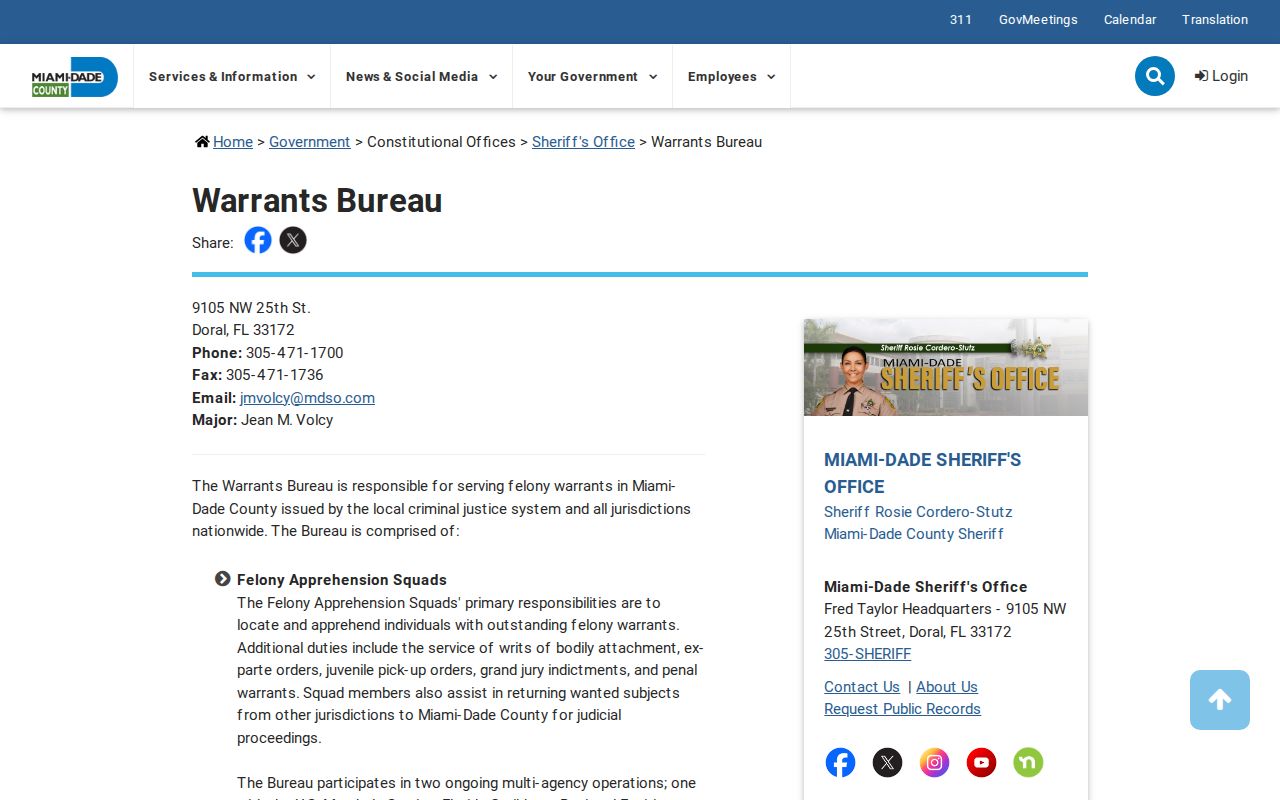
For warrant direction, trust the bureau over any unofficial site. A Clerk docket can point you toward a case, but it is the Warrants Bureau that speaks with authority on whether a warrant stands. Start there when you need a straight answer.
Note: Docket entries can lag, change, or get resolved, so verify current status through an attorney, the court, or official bureau direction.
Miami-Dade County Warrant Types
Warrant labels are shorthand. They hint at why a court or agency wants someone, but the order itself governs. Terms can shift too. Bond amounts, holds, surrender conditions, and hearing dates all move as judges issue later orders. So read the actual case docket and get official confirmation rather than guessing from a short label on a list or flyer.
| Type | General distinction | Safe next step |
|---|---|---|
| Arrest warrant | A court-authorized order tied to an alleged offense. | Confirm with the proper official channel and use counsel or court direction. |
| Bench warrant | An order commonly tied to a missed court duty or court directive. | Check the matching docket and contact counsel or the issuing court. |
| Specialized wanted notice | An agency-selected public appeal, not a complete warrant database. | Use the linked FDLE flyer and report tips without approaching. |
What a warrant does is authorize action. It rests on whatever legal showing was before the court at that point. From there, a case can travel a long road: first appearance, charging decisions, arraignment, motions, a plea or dismissal, trial, judgment, and finally sentence. The recorded outcome is called the disposition. That is the entry worth finding when you want to know how a case truly ended.
Miami-Dade County Warrant Court Trail
Miami-Dade has a useful local bridge between custody and court records: Clerk CJIS accepts the MDCR jail number. If an arrest follows a wanted notice or warrant, save that jail number from the county booking record and use it to locate the court case. The booking charge states what intake received. The prosecutor may file a different count or none, and a judge may later change bond or enter another order.
Names, dates, and locations can differ without either source being false. An arrest late at night may be booked after midnight. A facility assignment can change after TGK intake. A docket may reflect amended charges while an old news or wanted page still shows the first allegation. Record the wanted flyer, jail number, police number, and court case number together when available.
The Clerk divides local criminal work between Circuit Criminal and County Criminal operations. Felony and misdemeanor labels can help orient a search, but the actual case record controls. A short description on a wanted flyer cannot stand in for the charging document. Check the docket date, court division, party identifiers, and the most recent order. If several cases share a name, do not merge them. Each case can follow a different path, and one booking can lead to more than one docket.
Released does not mean cleared, and remaining in custody does not mean guilty. Follow each case to its disposition. When the online Clerk view is unclear, the Clerk offers certified case documents and disposition records through its official channels.
Miami-Dade County Wanted Source Boundaries
Think of each source as answering one question. The specialized MDSO page tells you whether the sheriff currently features someone in a narrow category. Crime Stoppers takes tips. Clerk CJIS lays out the court trail. The Warrants Bureau gives official verification. MDCR shows who is in county custody after booking. None of them covers all the ground alone.
Social media posts and news stories raise awareness, but they stay incomplete and can outlive a status change. Unofficial warrant databases confirm nothing. Instead, match more than one identifier and go back to the office that created the record. That habit serves public safety and fairness alike.