
Verify Miami-Dade County Crime News
Go to the government source behind the headline first. Miami-Dade County keeps its records in three layers. The arresting agency, whether MDSO or a city department, writes the arrest affidavit or incident report. Miami-Dade Corrections and Rehabilitation then books people at Turner Guilford Knight Correctional Center and holds the booking record, the custody entry, and the intake photo. The Clerk of the Court and Comptroller keeps the criminal case after that. Agency press releases and social media posts surface selected arrests, fugitives, and public-safety events. They are not a full blotter. Posts get edited or vanish, and no verified official booking feed exists at 24-hour, 48-hour, 72-hour, or weekly intervals for Miami-Dade. The MDCR Daily Jail Population Statistics report tracks aggregate counts and trends, but it lists no names, no person-level charges, and no photographs. A custody search answers one question: whether MDCR reports the person in county jail right now. It may not keep entries for people already released. The arrest report shows what police wrote. The Clerk case shows what prosecutors filed and how the court ruled. Keep those three documents separate, and a headline stops pretending to be a verdict.
Miami-Dade County News Mugshot Outlets
Four newsrooms dominate local crime coverage in this county. Editors pick stories for news value, not completeness. One case might run with an agency-released mugshot. Another gets scene video, a courtroom sketch, a family photo, or nothing at all. So the picture you see on a given day reflects editorial choices about what readers want. Nobody in Miami, Hialeah, Miami Gardens, or anywhere else in Miami-Dade County gets arrested in proportion to how these sections look.
| Outlet | Coverage | Photos? | Where |
|---|---|---|---|
| Official agencies | Selected releases and social notices | Sometimes | MDSO, MDCR, and city police channels |
| WPLG Local 10 | Frequent county and city crime reporting | Story by story | Local News |
| Miami Herald | Crime, courts, and investigations | Sometimes, with an MDCR source label | Crime section, sometimes paywalled |
| CBS News Miami | Local police and court stories | Varies | Local News |
| NBC6 | Countywide and city-tagged reports | Varies by story | Miami, Hialeah, and Miami Gardens tags |
The city tags help narrow geographic coverage, but a location name does not prove which police department made an arrest. A Miami postal address, for example, does not always mean City of Miami Police jurisdiction. Read the attribution in the story, then request the arrest record from the named agency.
The successful manifest capture comes from the Local 10 local news stream, the most active broad source identified in the research.
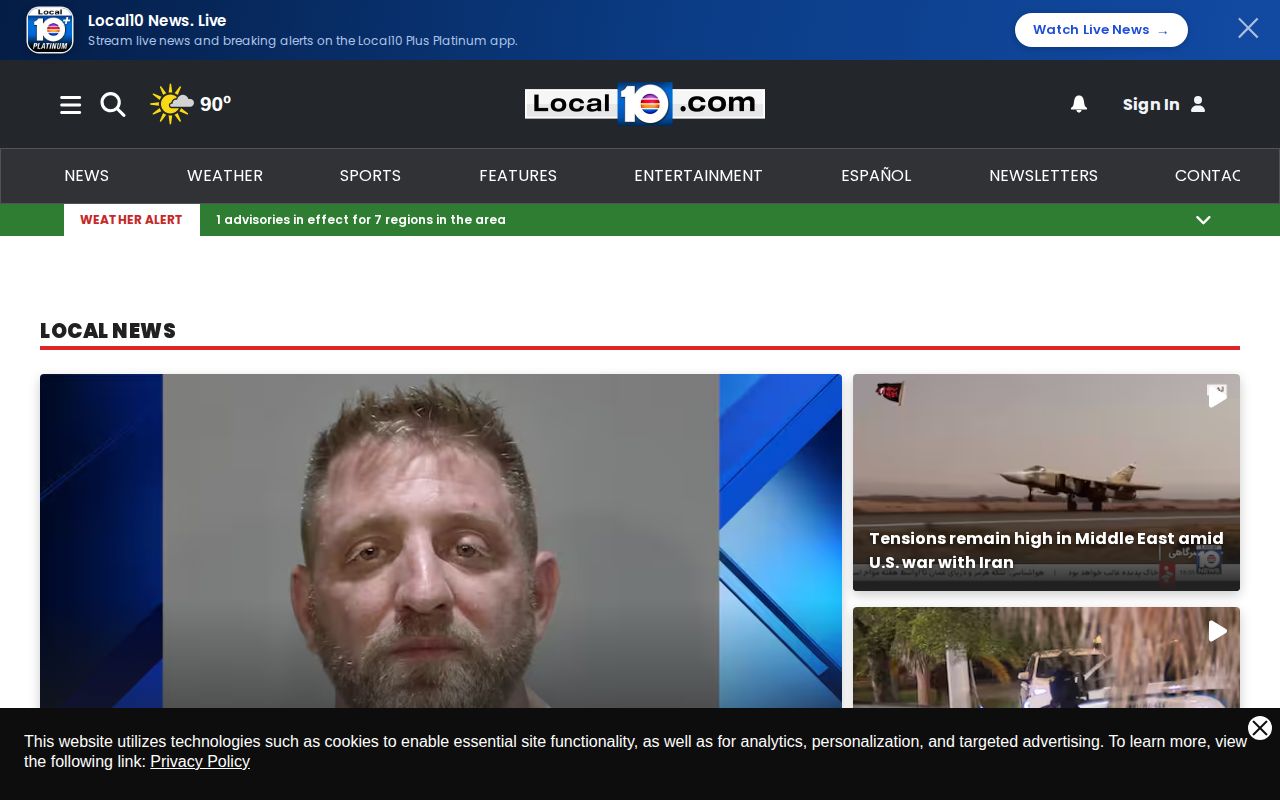
The section view shows how news is arranged as selected stories, not as an official or complete Miami-Dade County arrest feed.
How Local 10 Reports Miami-Dade Arrests
Local 10 publishes frequent Miami-Dade County and municipal crime coverage. Reports commonly attribute facts to MDSO, city police, arrest forms, inmate records, court appearances, or statements from officials. That source line is a practical map. It indicates which record to seek next and whether the first account came from police, corrections, or court.
Photos appear one story at a time. A booking image may accompany one case while another story uses scene footage or no defendant image. This pattern makes Local 10 useful for current reporting but unsuitable as a roster, trend sample, or count of arrests. News judgment favors unusual, serious, or high-interest events and does not mirror the full population processed by MDCR.
Preserve the story date and exact attribution. If a report says police alleged a fact, retain that framing until a filed court document supports more. When another source later differs, state the timeline: the arrest record listed one charge, and the later docket shows what prosecutors filed or how the case ended.
Note: Newsroom selection can magnify rare cases, so it should never be used as a measure of all Miami-Dade County arrests.
Miami-Dade County Mugshots Reach Newsrooms
Booking photographs can reach a newsroom through an agency release or a public-record request. Florida's public-record framework generally permits inspection and copying of nonexempt records, but exemptions, sealed or expunged records, juvenile limits, active-investigation rules, protected information, and victim protections can affect release. Public status is not the same as automatic web publication.
MDCR expressly says its in-custody search displays mugshots. That search covers current county custody, not every arrest or an archive of released people. For an older image, a reporter or member of the public can make a narrow request to MDCR Central Records for the intake photograph tied to one identified booking. The arrest affidavit may instead belong to MDSO or the municipal department that made the arrest.
Florida Statutes section 901.43 addresses dissemination by covered commercial booking-photo publishers and a free removal process. It does not require a newsroom to display every image, and it does not erase the source arrest or court record. A publication may also choose not to use a mugshot based on its own editorial policy.
Link Miami-Dade Booking News to Court
Miami-Dade offers a strong local bridge from booking news to the official case. The Clerk Criminal Justice Online Case Search accepts an MDCR jail number, along with a defendant name, case number, state case number, citation number, or police number. Saving the jail number from the booking record can reduce confusion when names are common or spelled in more than one way.
The court file can outlast the live roster. It may show first appearance, arraignment, bond review, charging documents, amended counts, motions, plea, dismissal, trial, judgment, sentence, and disposition. Arraignment is the hearing where a plea is entered. Disposition is the recorded result. Those terms describe later stages that a first-day article cannot know.
Two official records may differ because they capture different moments. Booking can occur after midnight even when an arrest happened the prior day. Bond may change by court order. A prosecutor may file a different charge or decline one. When the online docket is unclear, consult the Clerk and obtain the relevant filed or certified document rather than defaulting to the oldest headline.
The official case-search capture illustrates the record path used after an arrest story. Open the Miami-Dade Clerk case search and match more than one identifier.
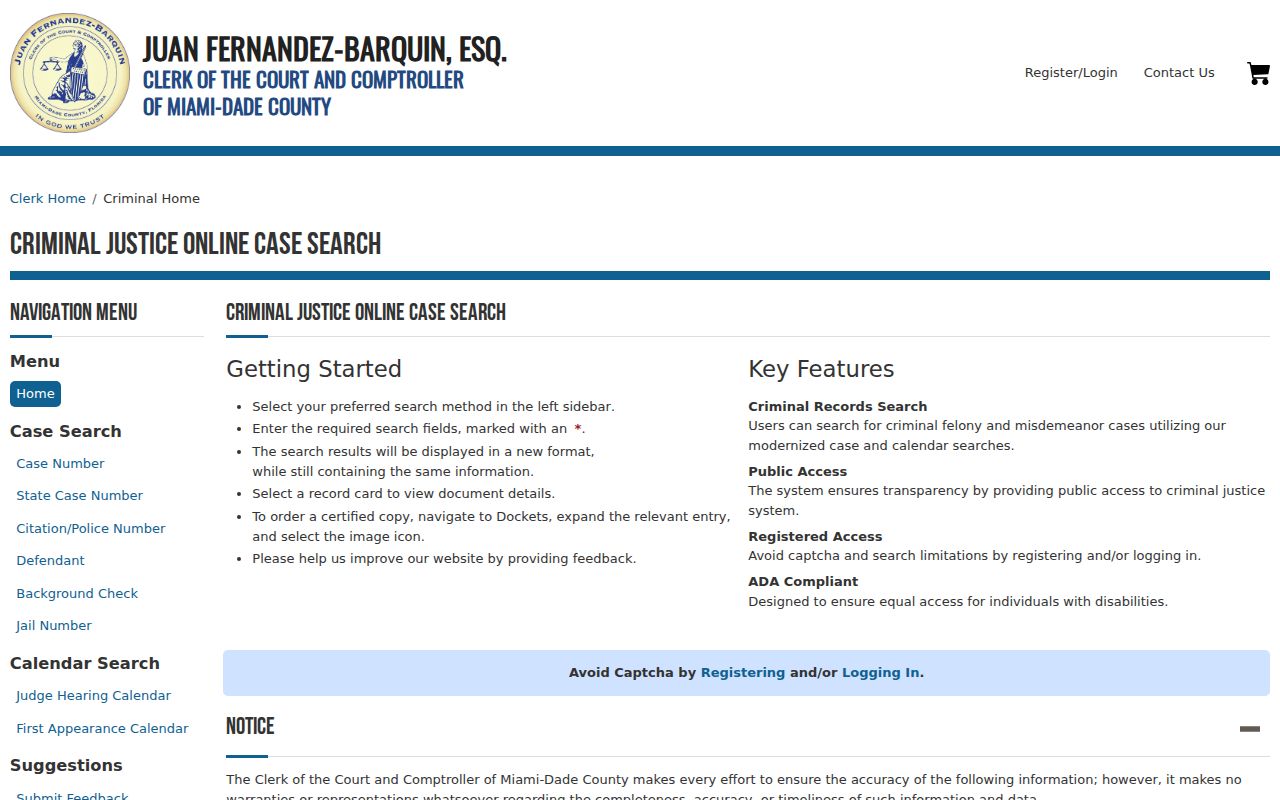
The Clerk's interface keeps the trail alive long after MDCR custody ends and the newsroom moves on to the next story.
Trace Miami-Dade County Arrest News
A careful search tracks the named event, not just a face. A shared surname is not identification. A loud headline is not either. Write down the outlet's timestamp, the arresting agency, and every official number in the report before opening the next source.
- Read the full story and identify whether its source is police, MDCR, a court hearing, or another newsroom.
- For current county custody, search MDCR and compare name, date of birth, booking time, facility, and jail number.
- If the person has been released, request the identified booking report from MDCR and the arrest report from the arresting agency.
- Search Clerk CJIS with the jail, police, or case number and locate the filed charges rather than relying on booking labels.
- Follow the docket to disposition and use a certified record when an authoritative outcome is required.
The Miami-Dade County busted mugshots search lays out the custody and booking-feed differences in full. No official named daily feed turned up. Today's roster can hold older bookings and miss a quick release. The daily statistics PDF carries only countywide totals, so it names no one.
Unofficial Miami-Dade Mugshot News Sources
Two commercial county pages exist beyond the official and newsroom channels. Busted Newspaper Miami-Dade posts booking-style items on a frequent cycle, and Mugshots.zone Miami-Dade has carried dated county entries too. Neither is MDCR, the arresting department, or the Clerk.
Expect gaps here. Entries can run late, repeat, or simply be wrong. Countywide listings mix Miami, Hialeah, and Miami Gardens without explaining municipal jurisdiction, so never guess the arresting agency from a city label. Check current custody with MDCR and case outcomes with the Clerk.
Several other names deserve a warning. RecentlyBooked's Miami-Dade route now returns a dead page. Mugshots.com and Arrests.org have no verified county landing page, and a lookalike spelling was deliberately left out. Pointing a reader nowhere is safer than pointing them at an imitation.
Miami New Times once ran a weekly Mugshots Friday feature. That example is historical. Archived habits can linger in search results for years after publication stops.
Note: No failed third-party screenshot or rehosted booking photograph appears on this page.
Miami-Dade County News Record States
Custody status shifts fast in Miami-Dade. A person booked today may show in MDCR's current search soon after. The county posts no schedule for that. A released person can vanish from the roster while the booking record still exists on request. A Florida prison sentence moves someone into the Department of Corrections system, far from the county jail search. Federal and ICE custody run through separate locators. Neither one publishes inmate photos.
A news story outlasts all of it, which is why its date matters. Police records hold the reported event. MDCR holds county booking and custody. The Clerk holds the filed charges and the outcome. Removal from custody does not mean a case ended.